Main Content

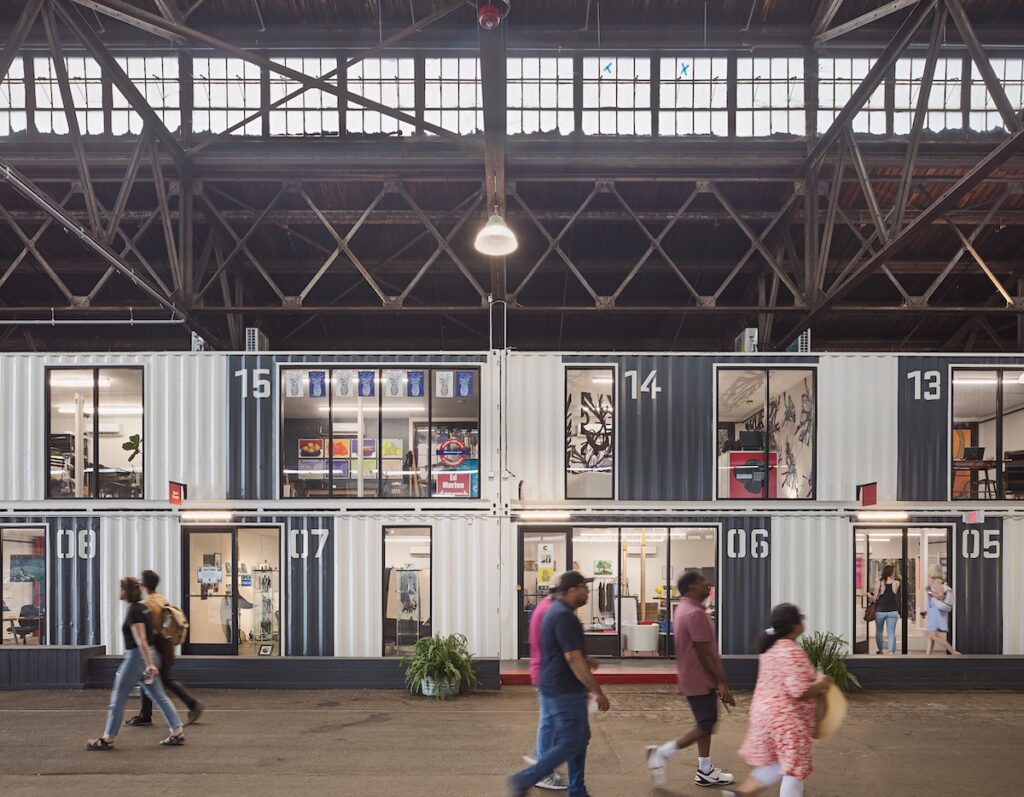
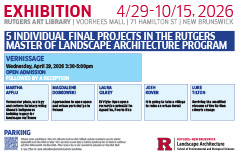
You are cordially invited to attend the vernissage of our grad exhibit at the Rutgers Art Library
Voorhees Mall, 71 Hamilton St, New Brunswick
3:30-5:00pm – followed by a reception
By Michelle Martel •

You are cordially invited to attend the vernissage of our grad exhibit at the Rutgers Art Library
Voorhees Mall, 71 Hamilton St, New Brunswick
3:30-5:00pm – followed by a reception
By Michelle Martel •
March 11, 2026

This lecture, “The Architecture of Erratics and the Vanishing Cryosphere,” will explore the ways humans and glaciers imprint themselves upon emerging landscapes to unearth the expanding realm of places, identities, and landforms negotiating the precarities of a post-glacial world. From site-specific landscape interventions and new approaches to drawing glaciers to the anticipatory staging of scenarios, these research and design projects bring together archival research, urban analysis, and fieldwork with technological experimentation and artistic practice to draw architectural lessons for shaping new worlds and ways forward.
Joyce Hsiang is an architect, urbanist and an assistant professor at Yale School of Architecture. She co-founded the research and design studio, Plan B Architecture & Urbanism, to anticipate and rehearse new relationships between humans and the earth. Her work uses cartographic analysis, design experimentation, and architectural implementation to examine how humans have transformed the earth and to reimagine design at the planetary scale. Projects range from immersive exhibitions and landscape installations to urban plans and global models of urbanization. Joyce has exhibited worldwide including La Biennale Architettura di Venezia (2021 & 2025), Lisbon Triennial, Istanbul Biennial, and Hong Kong Shenzhen Biennale as well as in Switzerland, Iceland, Abu Dhabi and at universities including Yale, Princeton, and Arkansas. Awards include grants and fellowships from Yale Planetary Solutions, MacDowell, the AIA Latrobe Prize, the Graham Foundation for Advanced Studies in the Fine Arts, the Hines Research Grant for Advanced Sustainability, MacMillan Center, the Franke Program in Science and Humanities as well as the inaugural Miller Prize from Exhibit Columbus. Her work and writing has been featured in diverse forums from Atlantic Cities, the Australian Broadcasting Corporation radio program Future Tense, the Arctic Circle Assembly and Kulturplatz SRF to Log, [bracket], New Geographies, Al Manakh, Los Angeles Forum, and Wallpaper*.
By Michelle Martel •
February 25, 2026
This well-illustrated presentation examines the varied landscapes that comprised colonial New Jersey. Indigenous, cultural, religious, agrarian, industrial, and commemorative landscapes are all explored. Special attention is paid to how landscapes shaped New Jersey’s Revolutionary War experience.
Richard Veit, Ph.D., RPA is a North American historical archaeologist whose research focuses on the colonial Middle Atlantic with specializations in vernacular architecture, commemoration, and conflict archaeology. He is the author of ten books on historical and archaeological topics, several of which have run state and national awards. He currently serves as Provost and Senior Vice President for Academic Affairs at Monmouth University.
By Michelle Martel •
February 18, 2026

Nodes, Edges, and Districts: Landscape Infrastructure for the City in Crisis
This lecture revisits Kevin Lynch’s city form-making elements as the primary framework for deploying resilient, multifunctional infrastructure in the face of contemporary urban challenges. Rather than viewing these as mere navigational markers or spatial frameworks, the lecture presents nodes, edges, and districts as elements of a multi-scalar landscape strategy to address the widespread environmental and social instability characterizing cities today.
Steven T. Lee is a landscape architect, urban designer, and planner based in New York City, with a passion for crafting meaningful and resilient public spaces. As a Design Principal at SWA/Balsley, he directs complex public realm projects domestically and abroad including waterfronts, urban parks, civic plazas, campus landscapes, and urban districts. Steven engages closely with clients, interdisciplinary teams, and designers across experience levels to foster shared creativity and develop innovative solutions. He holds a bachelor’s degree from Claremont McKenna College and dual master’s degrees in Landscape Architecture and City Planning from the University of California, Berkeley. In addition to practice, he has contributed to design education as a lecturer at Cornell University and a guest critic at numerous universities throughout the US.
By Michelle Martel •
March 4, 2026


Titled People, Place, Play, Travieso’s talk explores his creative practice through three guiding concepts that shape much of his work. People highlights his community-engaged process; Place refers to his approach of building from what already exists in a site—socially, physically, and historically; and Play speaks to his commitment to infusing joy, imagination, and interaction into everyday environments.
Chat Travieso is the Tepper Chair at Mason Gross School of the Arts. He is an artist and designer, as well as the co-founder of the multidisciplinary collaborative duo Yeju & Chat, with Yeju Choi. His practice encompasses community-centered urban interventions, public art projects, and research initiatives. His past work has been commissioned by or organized in collaboration with the Women’s Housing and Economic Development Corporation, the Children’s Museum of Manhattan, the Brooklyn Children’s Museum, NYC Parks, NYC DOT, the Cambridge Arts Council, and the Cleveland Public Library, among others. Honors include the Bronx Recognizes Its Own Award, the United States Artist Fellowship, and the NYSCA/NYFA Artist Fellowship. His research has been supported by grants from the Graham Foundation, the New York State Council on the Arts, the Mellon Initiative for Inclusive Faculty Excellence at The New School, and the Columbia GSAPP Anti-Racism Curriculum Development Award. His writing has been featured in Places Journal, AD (Architectural Design), MAS Context, and Urban Omnibus.
By Michelle Martel •

In this talk, Anita Bakshi will discuss how collaborative processes can be more central to design education. In Collaborations in Architecture and Sociology (Routledge 2026), co-authored with sociologist Zaire Dinzey-Flores, the authors address the disconnect between the design of the built environment and social life. They create a new interdisciplinary orientation and methodology, termed SOCIOARC, that recognizes the relationship of the built form and aesthetics to social experience. Anita will talk about the process of writing the book and explain how the graphic design strategy and original illustrations were used to create a book that is accessible to people from many disciplines, as well as its relevance for design education.
ANITA BAKSHI teaches in the Department of Landscape Architecture at Rutgers University. Following several years in architectural practice, she received her PhD in the history and theory of architecture from Cambridge University with the Conflict in Cities research program. Her research focuses on contested landscapes and histories, environmental justice, and the relationship between architecture and sociology. She edited the book Our Land, Our Stories: Excavating Subterranean Histories of Ringwood Mines and the Ramapough Lunaape Nation (2022), in partnership with the Ramapough Lunaape Turtle Clan. She is the author of Topographies of Memories: A New Poetics of Commemoration (2017), and co-author of Collaborations in Architecture and Sociology (2026) with Zaire Dinzey-Flores.
By Michelle Martel •
October 1, 2025

In the spring of 2020, Kathleen John-Alder initiated a study that explored the material and temporal dynamics of the Pine Barrens, one of the largest tracts of undisturbed land on the eastern seaboard, using soil, water, plants, and animals as material evidence. The study initially focused on the biotic community of the Pine Barrens, deploying field surveys, photography, archival research, interviews, and personal observations to capture the coloration of the various species of birds, reptiles, and butterflies that inhabit this landscape. Subsequent studies explored the variable surfaces, reflections, plant life, transparencies, and colors of water. Graffiti on abandoned brickworks documented the impact of anthropogenic actions. The work of Annie Dillard, one of the great natural history writers of the 20th century, served as a catalyst for the use of complete immersion as a way to see and know a landscape, and live responsibility within it.
According to John-Alder, the study flips the quantitative methods of landscape architecture to highlight visual beauty rather than functional value, thus becoming a means to interrogate disciplinary certainties. “I think I saw it as a subversive way to critique the discipline’s ways of seeing,” she observed in an interview for the article, “and if I did so, I wondered if this would foster a more inclusive attentiveness to other-than-human organisms, processes, and agencies.”

By Michelle Martel •
November 5, 2025

New Brunswick, New Jersey lies in the heart of the I95 Corridor between Boston and Washington, the most densely populated region of its size in the US. The city has even given itself the nickname “Hub City” in recognition, at least in part, of its location at a convergence of major highways. With all this density and development, it’s no surprise that to many who live in the area the idea of wildlife seems distant and alien. Wildlife belongs to wild places, and New Brunswick is certainly anything but that. But if you look closely, and listen, you’ll find a surprisingly rich diversity of animal life within a short bike or bus ride. In this presentation, I will share some of my experiences observing and photographing wildlife in the area and discuss how those observations connect with specific components of our very familiar local landscapes.
By Michelle Martel •
October 30, 2025
Amidst a striking change in the relationship between society and nature in the 1970s, Kienast sought a synthesis between design and ecology. As a designer, planner, researcher, and university lecturer, Kienast introduced new facets to those fields. Critiques of urban planning, processes of participation, and the significance of spontaneous urban vegetation played just as prominent a role in these discussions as did art, literature, architecture, and the popularity of postmodernism.
Dr. Anette Freytag, who has written a critical monography on Dieter Kienast explains on the Landscape Architecture Platform Landezine, why his work is so important and influential to this day. To honor Kienast, his Ten Theses on Landscape Architecture have been translated into English and put online.