Main Content
Organization
Marvel Architects | San Juan, Puerto Rico
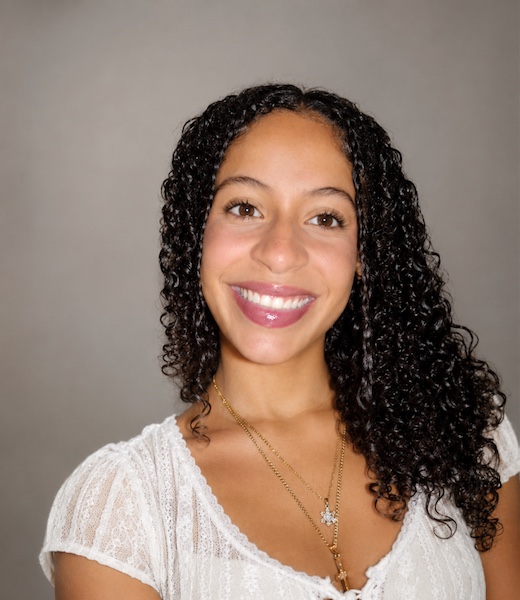
My name is Karessa Falcón-Jiménez and I was a landscape architecture intern, Summer ‘26, at Marvel Architects | San Juan, PR office. This Fall I am going into my junior year at Rutgers University-New Brunswick, aiming to complete a Bachelors of Science in Landscape Architecture alongside minors in Architectural Studies & Urban Planning and Design. I am very fortunate for the opportunity I had to grow as a professional this summer under the guidance of Jose-Juan Terrasa-Soler, Ramon Irizarry, and Ruben Alejandro Hernandez Diaz. My focus project was on Isla Guachinanga Public Park; a project that bridges community wellbeing and growth in the Cantera Peninsula alongside the environmental stabilization and ecotourism of Guachinanga islet. In my free time I enjoy competitive sports, particularly soccer and volleyball, dancing, and volunteering at my local animal shelter.
This summer I had the opportunity to work alongside la comunidad de Cantera and Marvel Architects to generate a revised plan for Guachinnaga Islet. Through detailed research of previous design parameters, community history/culture, and the watershed routes, I was able to approach the site analysis and visit of Guachinanga with a thorough lens. Working with Fernando Silva, one of the main advocates for the project, who researched and worked with the community for over a decade to draft the original design guidelines and tour routes on the islet and in the lagoon.
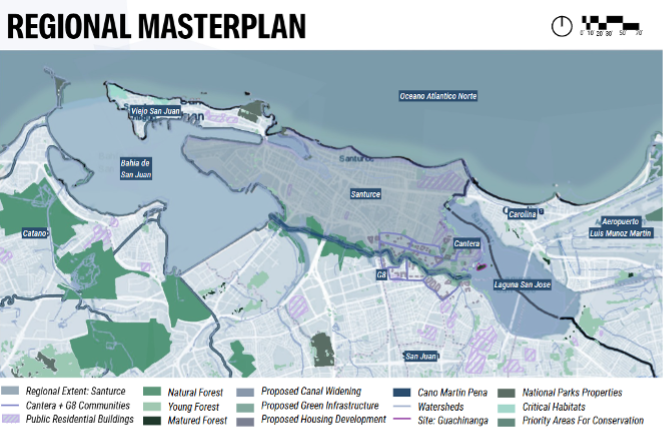
During my time in Puerto Rico I was able to connect with community leaders during several meetings to understand how Cantera was being affected in real time and their vision moving forward. Understanding the water system was one of the main considerations for drafting the design, as not only Cantera, but several barrios, and Guachinanga health have diminished due to the contained water source. Caused by decades of urbanizations decreasing the overall size of Cano Martin Pena, that directly connects San Juan Bay (Estuary System) to San Jose Lagoon (Guachinanga is located), and using the water body as a landfill. This had lasting effects on Guachinanga, as the contamination created a vegetated land bridge, connecting Cantera with the Islet which if left for a long period of time would be detrimental to the islets ecology. With the growth of mangroves directly on top of the debris, to restore the health and aesthetic appeal of Guachinanga it is necessary to undergo the process of dredging the material, including the mangroves, which can be repurposed in a multitude of ways. Luckily, through community involvement and several organizations the process of dredging the channel, and some of the vegetated land bridge has already begun. However, more funds are needed to complete the restoration process.
Our next steps were to create as much of an ADA regulated pathway (understanding to protect the natural conditions of the site that only some spaces could follow these guidelines), with several key points, that could be integrated for tours operated on the islet offered by community members of Cantera. Understanding the project on a local as well as regional scale was necessary to not only boost the economy of the community but more importantly the overall health of San Juan.
“We abuse land because we regard it as a commodity belonging to us. When we see land as a community to which we belong, we may begin to use it with love and respect.” — Aldo Leopold
Through this internship experience, I value and understand the importance of working hand in hand with the community to understand the varying perspectives in the designing process. I appreciate how welcoming the community leaders of Cantera were, including their effort and time, during this Summer. With a special shout out to Maria Gabriela Huertas Diaz who organized public meetings on our behalf. During this summer I was able to learn the principles of Revit, which puts me on a better foot moving forward, in learning 3D modeling softwares during my Junior year at Rutgers. This summer has not only left me with a valuable learning experience, professional development, unforgettable memories, but also a better understanding on how Architecture offices work to produce beautiful sustainable designs.